We’ve got a special Christmas treat for members of our Resource Base – a new Musescore plugin!
Subscribers to our Resource Base have long been able to download a plugin for Musescore that allows you to change the noteheads to Figurenotes colours with one click, giving you stage 3 Figurenotes notation at the touch of a button. Now we have created a transitional tool allowing you to do even more.
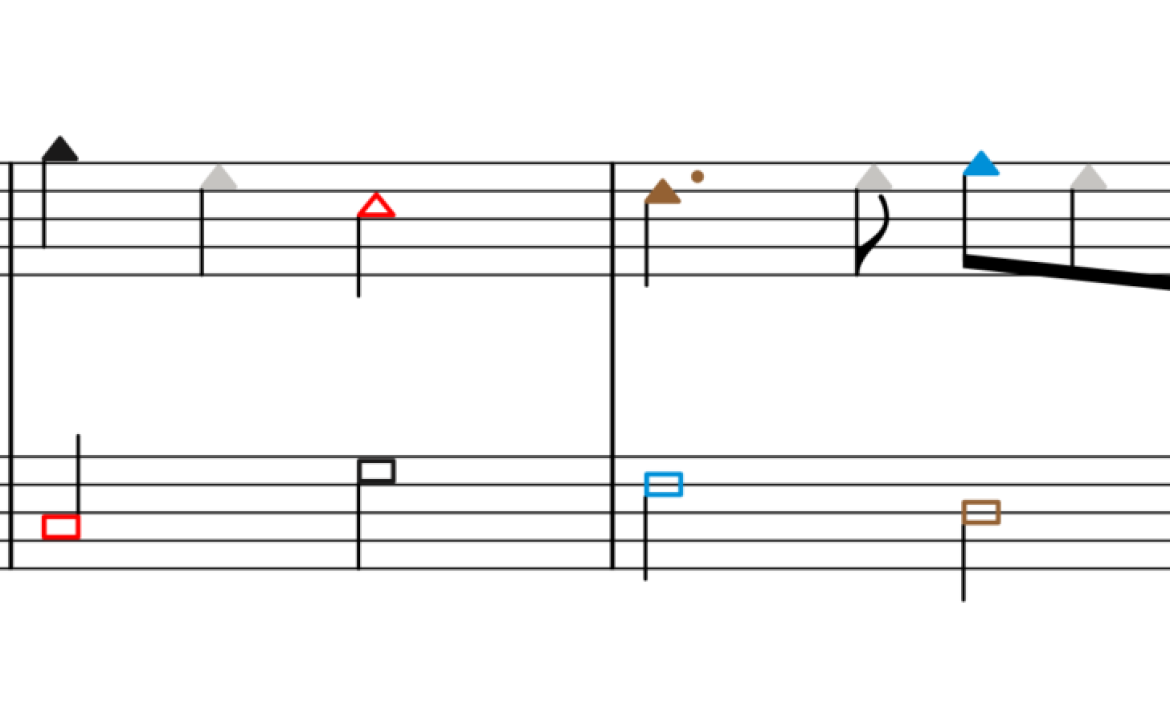
If you want to ease your pupils into stage 3 notation more slowly, you can now use shaped noteheads with Figurenotes colours with our latest plugin.
Using the new plugin to create shapes and colours
Using the plugin just for coloured noteheads
Using shaped noteheads in this way allows pupils to adjust to the new stave appearance more gradually. Shapes can help reassure players that they are in the right octave, while still progressing their rhythmic reading.
Write your piece in Musescore or import it from the Figurenotes software. After highlighting the piece, click on the plugin in your Musescore menu to change the piece to either stage 3 or the new transition stage. Easy!
Once you’re logged in, you’ll find the new plugin under ‘Software Resources’, along with a Sibelius plugin and instructions on installing the new plugin.
Not a Resource Base member? Sign up today for only £23.99 a year – that’s less than £2 per month!
Membership will give you access to a huge bank of tunes, lesson plans and resources you can adapt to suit the needs of your pupils using the Figurenotes software for mac or PC.
From its establishment in 1997 Drake Music Scotland’s primary purpose was to create music-making opportunities for disabled people of all ages. For the first 10 years this was primarily achieved through the use of accessible music technologies, giving those with limited mobility and co-ordination the means to control musical sounds and express themselves creatively. As well as working with physically disabled people, we also provided opportunities for those with learning difficulties. Many of these were able to play conventional musical instruments, but the main issue for us was how best to help them develop musical skills.
The ability to read music notation is a fundamental aspect of learning to play an instrument and joining in music making with other people. Notation presents a barrier for many learners – not just those with disabilities – and we hadn’t found a way round this. We relied on different approaches to music making, such as improvising, rhythm games, playing by ear, and creative composition using alternative notation such as graphic scores.
Essentially we recognised our own ‘teaching difficulty’ rather than seeing our participants as having a ‘learning difficulty’.
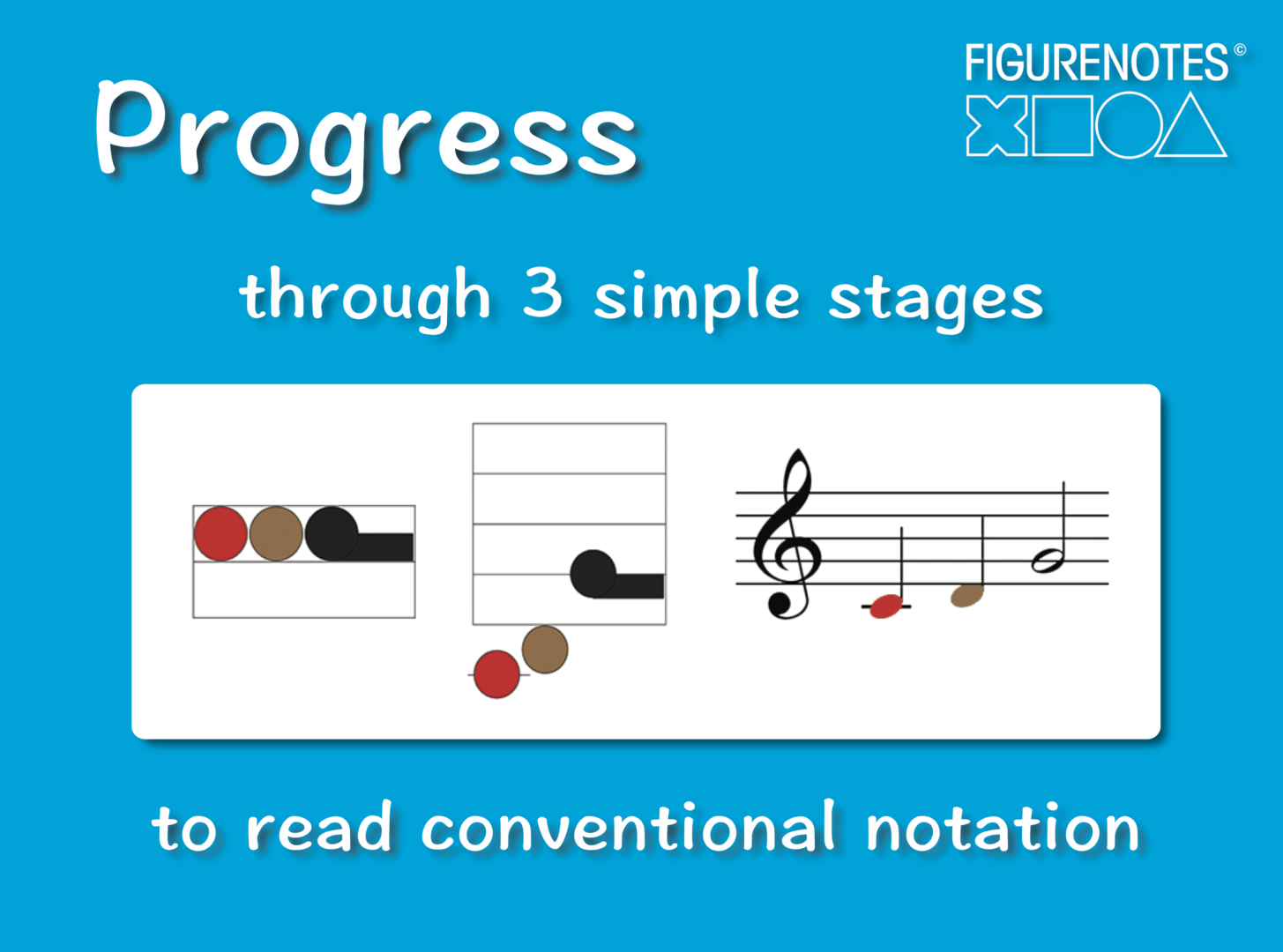
In 2008, we became aware of Figurenotes and, since that moment, this colourful notation system has had a major impact on our work. Our former Artistic Director, Brian Cope, went to Helsinki, where Figurenotes was invented and developed by Markku Kaikkonen and Kaarlo Uusitalo with their pupils at the Resonaari Music School. He returned to Scotland enthused by its simplicity and effectiveness, and we didn’t look back. Although other colour-based systems have been created, Figurenotes presents all the fundamental features of notation in a clear and accessible way, and at the same time allows learners to progress through three simple stages towards standard notation. Following our ‘Inspire’ pilot project, testing Figurenotes with a variety of learners from young children to adults, we needed no further convincing. Our mission was to introduce it to Scotland, make it more widely available by creating Figurenotes software and resources, and bring music leaders and educators on board with this revolutionary, but simple tool.
Over the last ten years, Figurenotes has had a pervasive and positive effect on all aspects of our work. As we reach the major landmark of our 20th Anniversary Concert, putting disabled musicians ‘Centre Stage’, it is enlightening to assess the impact it has had. Rather than being a dramatic ‘solution’ to everybody’s needs, there has been a gradual growth of confidence in our flexible methodology. A combination of the right kind of open-minded, creative and versatile people – musicians and music educators – with the best combination of tools, teaching practices and technologies to create a holistic approach that can be adjusted to meet the needs of any learner, seeing opportunities instead of obstacles, and allowing people’s potential and talent to be realised.
Highlights
We have had many successes with Figurenotes, both on a small individual scale, at organisational level and in terms of the wider sector both here in Scotland and further afield. Creating a list of our ‘Top Ten’ achievements with Figurenotes is nearly impossible, but here we highlight some of the major ways we have helped our participants realise their potential with the brilliant Figurenotes system over the last 10 years:
Winning the award for Best SEN Resource at the Music Teacher Awards for Excellence
This award was in recognition of everything we had achieved since launching Figurenotes resources in 2012. It was the first in what is now a much longer list of awards and accolades won by Drake Music Scotland.
Collaborations between mainstream and special schools
Increasingly, Figurenotes is enabling pupils from all schools to play together in concerts and collaborations. Many of these pupils would not have had this opportunity without Figurenotes. One of the highlights was our Mambo concert in Angus that featured in the BBC Ten Pieces newsletter.
Links with national organisations to increase accessibility and inclusion
Our resources for BBC Ten Pieces, Friday Afternoons, and links with Sistema Scotland have given so many more people access to music making. It is great to see these projects increasing their focus on inclusion and accessibility.
Recognising our work finding digital solutions to break down the barriers to music making for disabled people, including development of the Figurenotes software. Our music software is now used world-wide by teachers and students alike. A great tool for composition and for adapting pieces to the needs of the musician.
This research project helped us see the huge potential of Figurenotes and it’s effects. The orchestra frequently plays with top musicians such as Sir James MacMillan, Nicola Benedetti, and Colin Currie. Prestigious performances in both Holyrood and Westminster prove that learning with Figurenotes can take you a long way.
From a pupil moving to a mainstream school to study music after learning with Figurenotes, to a pianist with Dyslexia who is now training to be a music teacher. We absolutely love hearing back from projects all over Scotland and further afield. Access to Figurenotes resources has helped brass projects in the favelas of Brazil, school work in Uganda, Israel, Australia, Europe and the USA; the list goes on.
Tirelessly training teachers
We have been training teachers and musicians to use Figurenotes to increase accessibility, inclusion, and success for years. Our Music Teacher’s Toolbox training days go from strength to strength, attracting people from Australia, Czech Republic, Sweden, among others. We have seen an increase in training requests from organisations, schools, and companies, which means more teachers using Figurenotes and more people gaining access to music making.
We are looking forward to the biggest highlight of all: Centre Stage
Not a sentence that many people in the UK have uttered in the last week, but we have been extremely lucky with the weather! Why? Emma, Pete, and Lauren just managed to get out of the country before all flights were cancelled.
Boston played host to the Massachusetts Music Educators Association (MMEA) Conference 2018. Drake Music Scotland and Figurenotes took to the stage, presenting on Figurenotes notation, technology, and inclusive music practice. We had been invited to present following the work of one Boston teacher fighting to improve provision for students with additional support needs. There are brilliant things happening in Scotland in this field, and Massachusetts’ teachers were keen to get ideas to take into their classrooms and propose to their decision makers.
“I wish I’d had this when I was learning”
“As a person with Dyslexia, it is a big deal for me to be a music major. We tend to get weeded out of music programmes. [Figurenotes] would include us!”
“This is just the best thing I’ve seen.”
“That progression makes total sense. So we can get all the kids playing and reading? That’s amazing.”
The wonderful feedback we received and the enthusiastic response from teachers made the long trip worthwhile. Some music education focuses attention on the most ‘gifted and talented’ pupils, often those who have already had the privilege of private music lessons. Making classroom music more accessible will include students who are often left behind or not given the chance to learn, as well as increasing engagement in the extra-curricular music activities within the school. Increased confidence from quick success makes motivating your class much easier, with no pupil left behind. It was wonderful to see the ‘lightbulb moment’ as these teachers understood what would now be possible in their classrooms. That was definitely worth travelling over 3000 miles for!
If you want advice on how Figurenotes could be used in your school, get in touch. Our next Music Teacher’s Toolbox training event will take place on Saturday, 24th March 2018. Take a look at the programme and book your place today.
Rhythm is the heart of Figurenotes. From banging out beats on the drum kit, to beautiful marimba solos, you can work wonders with Figurenotes percussion. With studies showing that musicians using Figurenotes have a stronger sense of pulse and better rhythmic skills, let’s take a look at the different methods of using percussion:
1. Drum kit
2. Pitched Percussion
3. Unpitched Percussion
Drum Kit
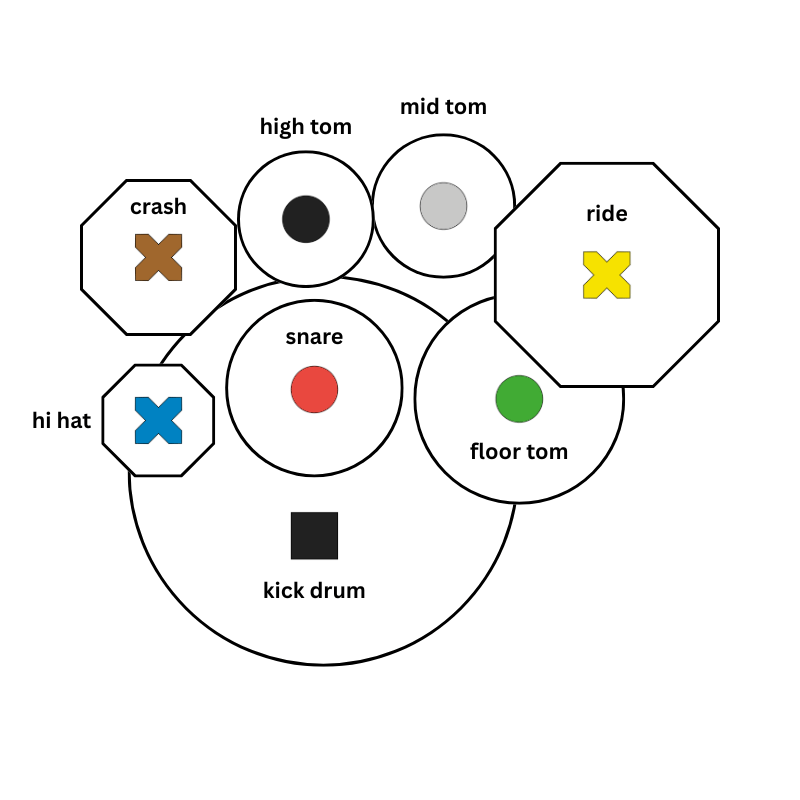
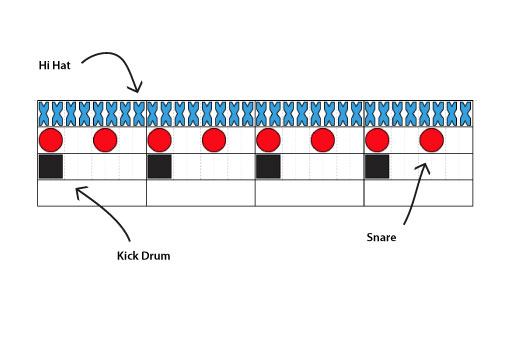
The diagram above shows the structure of both the drum kit and the drum notation.
A black square represents the kick drum. Circles are the snare and toms. Crosses represent the cymbals.
The notation puts these shapes on 3 different lines. Kick drum squares sit at the bottom, circles in the middle, and squares on the top. This echoes both standard drum notation and the physical placement of the kit. This moves onto 5 lines in stage 2 Figurenotes notation.
Tuned percussion works in the same way as piano. We place stickers on the instrument and match them to the note on the page. The diagram below shows a piano with Figurenotes stickers. The red circle is middle C.
When learning chime bars and similar instruments, we recommend placing the sticker where the beater will strike. This helps musicians to learn where to play the instrument for the best sound.
You can limit the amount of notes you present by limiting the chime bars you lay out, or removing unwanted notes from a xylophone or glockenspiel.
Unpitched Percussion
Untuned percussion gives you a lot of freedom. You can assign any shape or colour to a sound/instrument. You can choose to add stickers or not.
In some settings, it helps to keep this consistent from week to week. Other times we may want flexibility to change instruments and keep the same parts, for example. This is up to you.
You also have the option of writing each individual part out as a melody line using your chosen colour and shape, or lump parts together into drum kit notation explained above. See what works for you and your musicians.
For more structured untuned percussion, see the drum kit example above.