Well, we are nearly there. You’ve heard your pupils play Jingle Bells approximately a bazillion times and you are ready to park yourself by the fire with a well deserved mince pie. Before you get cracking with the Christmas cheer, we thought we’d better give you some wee housekeeping news.
In order to get your parcels in time for Christmas or the new school term, you must get your UK orders to us by 10am on Thurs 21st December, 2017. Make sure you choose a 1st class postage option. These will be posted out the same day, so it isn’t too late to grab your Festive Figurenotes pack, or magnets as a stocking filler.
Our office will be closed over the Christmas break, from Friday 23rd December to Monday 8th January, 2018. Please note that, due to staff availability, orders may take a little longer to be processed during the first few weeks of January. Normal order should resume on 22nd January, 2018. Software and Resource Base subscriptions ordered through the online shop will be sent my email, so you’ll get immediate access.
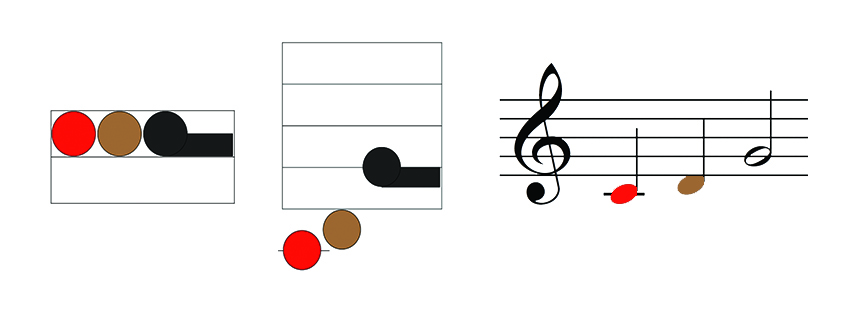
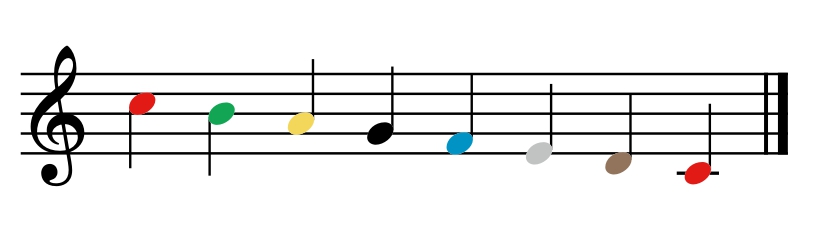
Until now, stage 3 has only been available via plugins (available from the Resource Base) for use with Sibelius or MuseScore. Now, the people at Steinberg have incorporated a one-click option without the need for a plugin. This is available within their notation software, Dorico. Get the latest update, launched on 5th December, to access this feature.
By using the Figurenotes Colours feature, you also get larger note heads, making the notation clearer to read. Your sharps and flats remain in black, regardless of the note colour; this seems to be a big plus within our Figurenotes community!
If you don’t use Dorico, remember you can still access plugins for stage 3 from our Resource Base for Sibelius and MuseScore. Stages 1 and 2 can be created using our own Figurenotes Software. Please check our FAQs before buying.
Having even more ways to access Figurenotes is a huge boost to inclusive music education. We are extremely pleased that Dorico recognises the need for accessible notation and that Figurenotes is part of that process.
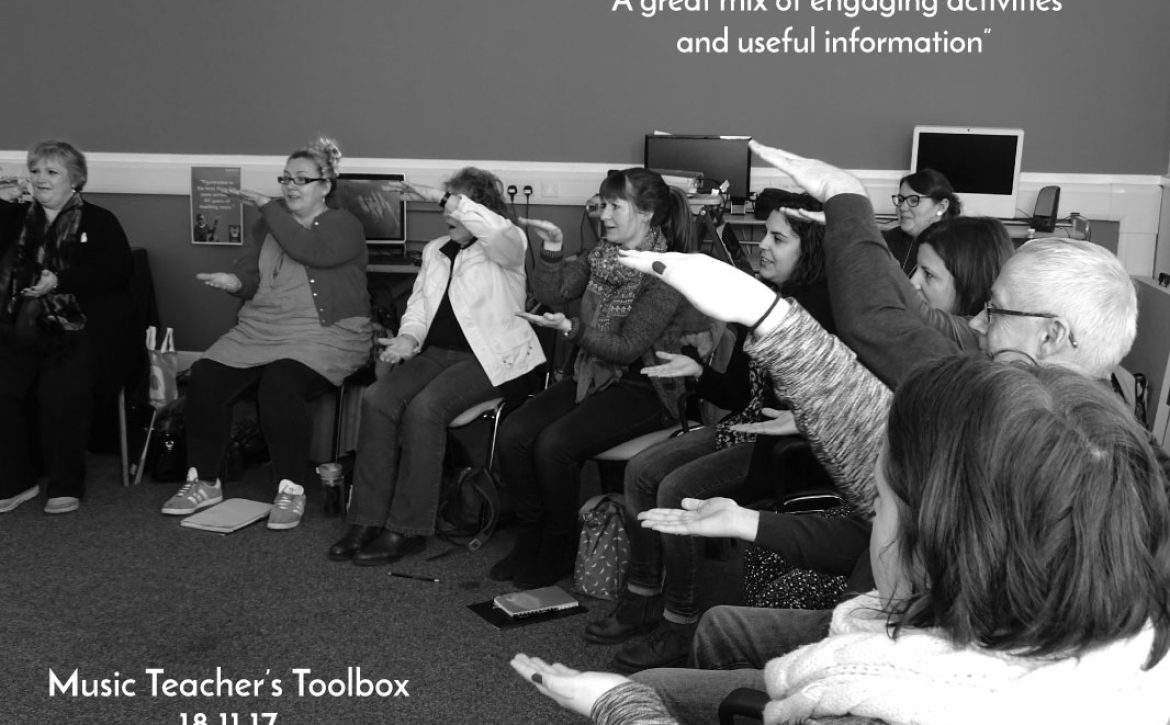
A vibrant group of people attended last week’s Music Teacher’s Toolbox. We had a mix of mainstream teachers, music specialists, music therapists, SEN/ASN teachers, and community musicians. Two teachers travelled all the way from Barcelona, continuing our tradition of attracting an international crowd!
“Good to get ideas for using/introducing Figurenotes into classroom teaching. Good to hear how other people use the software. Nice mix of activities. Thank you. It was a really fun day :)”
“No matter how often I attend these training days there is always something new to learn, and new ideas to share and take back. Great day meeting lots of interesting people and thinking about new ways of working.”
“Excellent notation system to support all leaners. Looking at ways to introduce simple music making to young people was really useful. The most valuable part of the day was getting the chance to play the instruments using Figurenotes and looking at composing.”
The feedback has been wonderful and we can’t wait for the next one. We really enjoy seeing everyone brimming with ideas and ways to apply what they have learned to the people they work with.
If you missed out this time, or want to attend another training day, booking will be opening soon for Music Teacher’s Toolbox, 24th March 2018. Sign up to our mailing list for more information, and keep an eye on Twitter and Facebook. Book early to have a say in what we cover, as we like to tailor the training to those attending.
“I’m so glad I came to talk to you. This is great!”
“Ooh, this looks fun!”
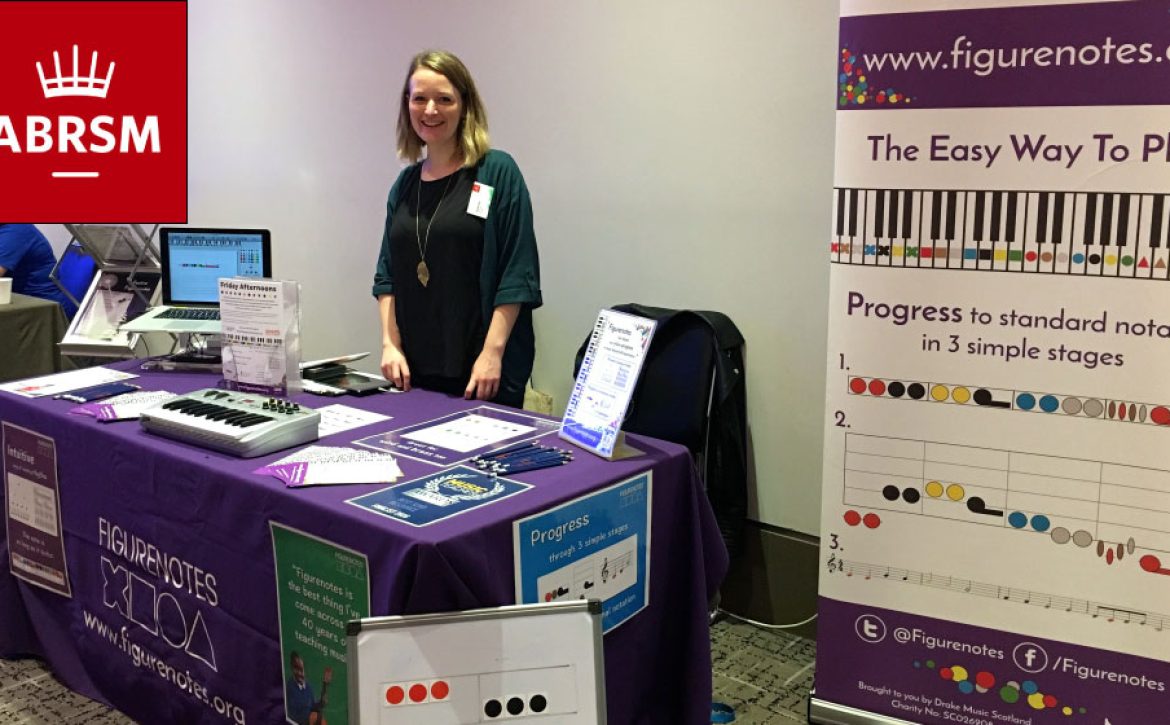
Lauren and Emma were greeted with lots of big smiles and lightbulb moments during the ABRSM Conference. Many teachers are looking for extra tools in areas where their students may struggle; some just want a way to make theory or rhythm more fun. It was lovely to connect with teachers in different settings and working with a wide range of pupils. We were able to show how adaptable Figurenotes is for each setting and activity.
Figurenotes was mentioned by Jenni Parkinson in her session ‘Teaching Students with Disabilities and Specific Needs’, which meant a new crop of teachers excitedly approached our stall. We love it when experts share what they use and give people an idea of the tools available. We are thrilled to be one of those tools for Jenni.
Our magnets and rhythm games proved very popular. Teachers could see the benefit of these games straight away, without much explanation from us. The magnets and games can be used to instil pulse and rhythm through practical and engaging activities. You can sneak a lot of theory into a game too!
This year, there was increased interest in bespoke training for music hubs, especially in the south east of the UK, where Figurenotes is gaining popularity. Teachers are recognising that Figurenotes isn’t just for people with additional support needs, but works for all beginners. This is what we mean by inclusive music. By using Figurenotes in as many settings as possible, we are able to support each pupil’s needs, while making it easier for everyone to learn music.
For those that can’t wait for bespoke training, try Music Teacher’s Toolbox. Award-winning training for music practitioners and educators, these hands-on days of CPD will help you to unlock every pupil’s potential in an inclusive environment. Join us in Edinburgh on Saturday, 18th November, 2017. Only a couple of spaces left.
There are manyways to learn guitar using Figurenotes. The route you choose will depend on the style of music you want to play, whether you play solo or in a band, and the way that your body works. Today, I am focusing on playing chords.
Figurenotes Guitar
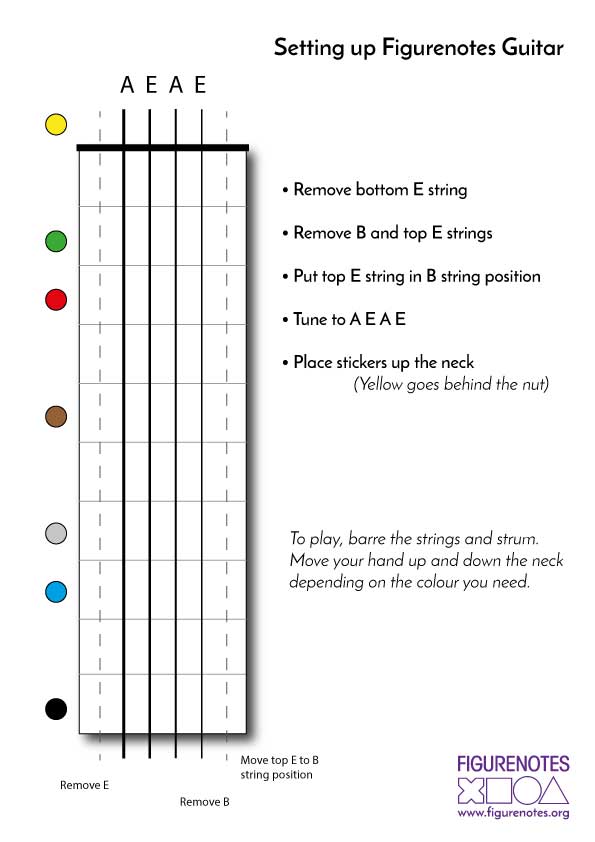
This method is great for bands, as well as those that want to cement the basics of guitar playing fairly quickly. We can use Figurenotes guitar as a good basis for learning to strum, changing the hand position in time, and synchronising the two. You can also play Figurenotes guitar a number of ways, including flat on the lap, which is especially useful for wheelchair users.
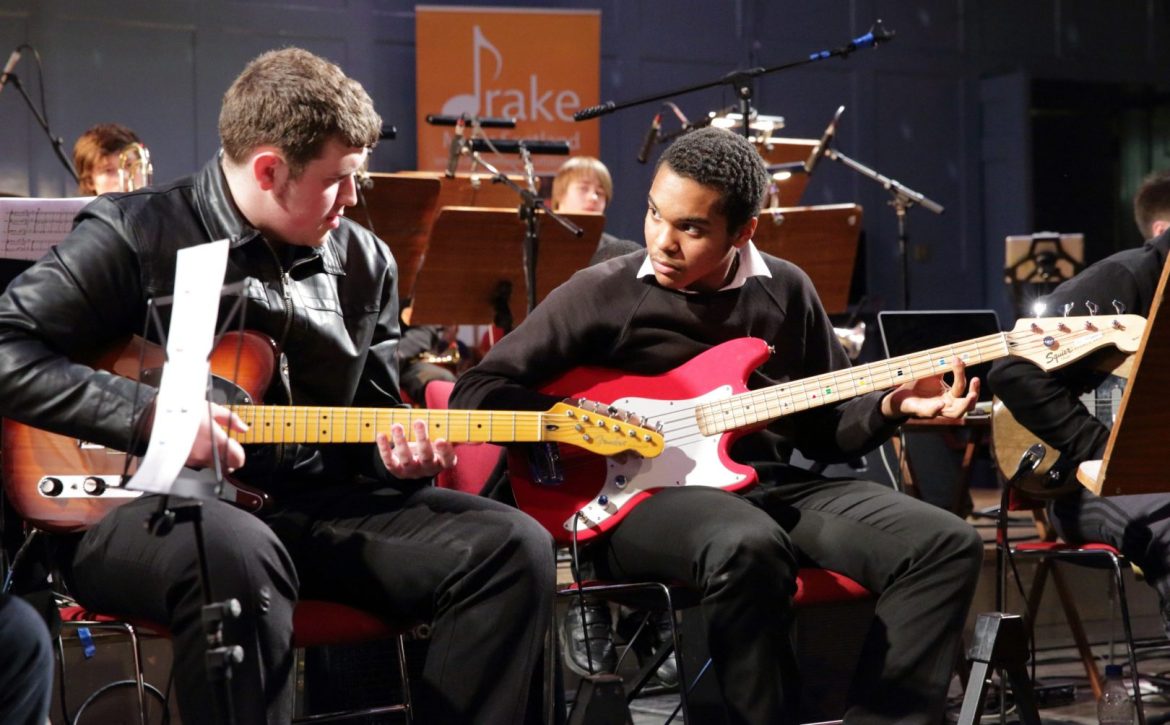
We start with 4 strings – A, E, A, E. This creates a chord with no third, meaning we can play this in our band without worrying about major and minor just yet. We can barre the strings to create different chords. In order to make this easy, we place stickers up the side of the neck, so the guitarist can see the colours clearly. Match the note on the page to the sticker on the instrument and barre where it says. As there are only 4 strings, we can barre more easily than with 6. If strength is an issue, try using more fingers or lay the guitar flat on your lap and use your thumb, a bit like a slide guitar.
Remember that playing this way involves taking off and moving strings, so get your teacher to help you.
Fancy taking the solo? You can see in the video below that there are also stickers on the fretboard by the top string. Use these to play your solo or melody line. The stickers are placed on the natural notes, not sharps or flats.
Traditional Chord Patterns
When teaching standard chord patterns, try putting stickers just in the position of the chord pattern. So, if we start with the chord of D, for example, we might place all brown stickers to show the shape, or we could stick the right colours for the fingered notes, showing the shape of the chord. You might start with two chords and progress on from there.
Once a chord has been learned, try taking those stickers away. We do not recommend keeping lots of stickers on the instrument at once. Move slowly and memorise as much as you can.
Alternative Tunings
There are many different tunings you could try. A good place to start might be D A D A A D.
You can start by playing one finger on just the bottom string, with stickers along the neck. Then try a barre on the bottom 3 strings (or using 3 fingers, if a barre is too much). Only strum the bottom 3 strings. You can also try a whole barre, if you have the strength.
There are further stages you can go through to progress towards a drop D tuning, before finally coming to standard E tuning.
Tune your bass in the standard way. Place some useful stickers, up to the 5th fret for example, on the fingerboard itself, rather than down the neck. Put stickers for the open strings on the other side of the nut. Don’t cover the entire fingerboard in stickers. Only the necessary frets and strings that you will start with. You can add and take away stickers as required.
There are Figurenoters doing some brilliant things with brass. Take a look at Favela Brass in Brazil as a prime example of what can be achieved.
We are in no way dictatorial about how you use Figurenotes with brass instruments, so this blog will be a series of ideas for you to take away. I will focus on the trumpet, for ease, but these methods can be adapted for different instruments.
Teaching brass with Figurenotes can be just the same as with conventional notation. You teach each note, the valves/fingers you use, or the slide position, and associate this with the note/colour. However, if you want to use something to reinforce this learning, try the ideas below.
Resonaari
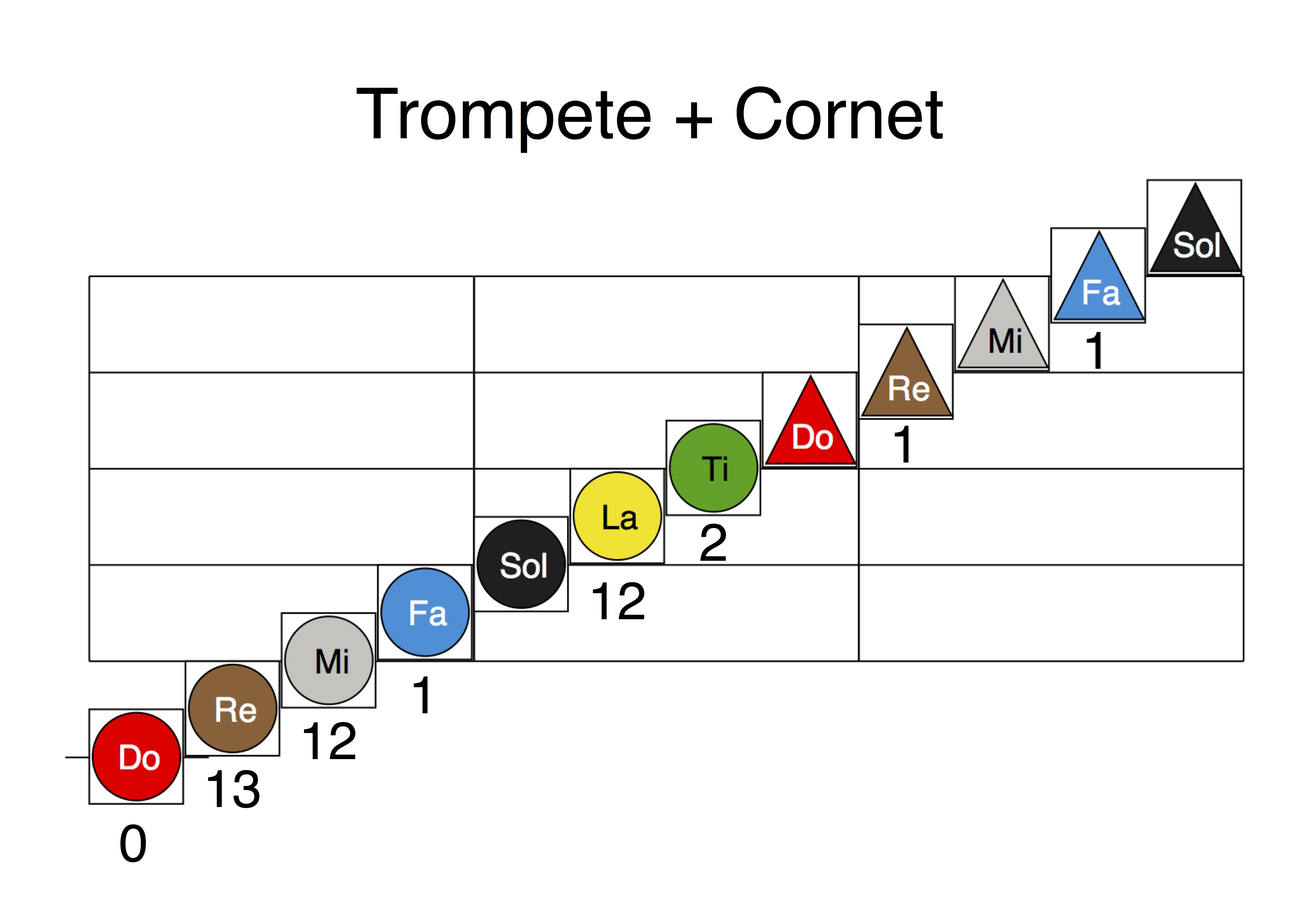
Resonaari, the Finnish school where Figurenotes was created, uses lines above the notes to show which valves need to be used. Use this to learn the notes and then try to limit their use in pieces. Try to reinforce the colour, maybe the letter name, in order to progress with reading. These lines are easily written on your Figurenotes score using a pencil or marker.
Favela Brass
Favela Brass in Rio de Janeiro uses a different method to show how to play each note. They use numbers to show which valves to use. This would also work well for trombone, as you can use the numbers 1-7 for the slide position instead.
We covered transposition in our Working with Woodwind blog, so if you have questions about transposition, I suggest you go back and take a look. Use these tools to help teach individual notes and/or scales.
Teaching with Figurenotes needn’t be vastly different to your normal teaching style. Just as in the woodwind blog last week, you can teach notes in your normal style, but use colour and patterns to reinforce this learning.
Be aware of your pupils’ needs and use the right approach for them. Let us know if you have another way of teaching brass with Figurenotes. We’d love to hear your thoughts in our Facebook group: Figurenotes – Let’s Make Music.
For the second instalment of our mini-series on how to use Figurenotes with different instruments, we will focus on woodwind. In the last blog, we covered strings and how to get started. This focused on violin, but can be applied to viola, cello, and double bass.
Let’s break down the most common questions we hear when discussing Figurenotes and woodwind instruments:
Where do I put the stickers?
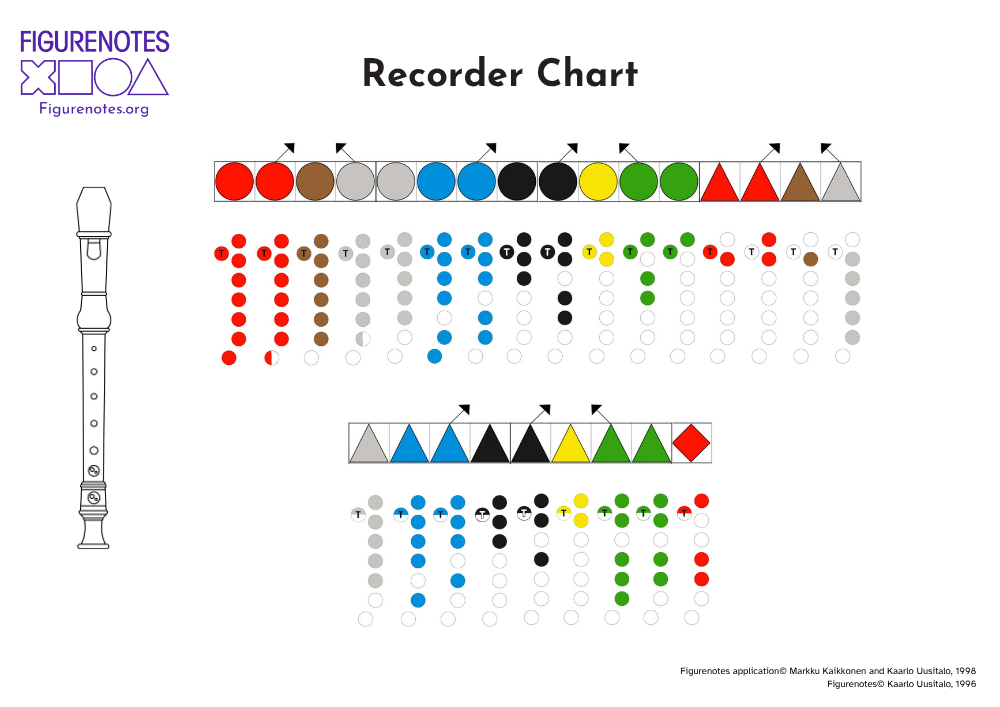
Figurenotes for woodwind is very similar to using standard notation. You teach fingering and notes, just as you would with standard notation. You replace the note on the stave with a Figurenotes coloured shape instead, e.g. B on recorder is a green circle. This means there is no need for Figurenotes stickers when teaching woodwind. The colour helps the pupil to distinguish between notes, which builds up a strong association between note and finger pattern. It is up to you whether you call it by the letter name or the colour (or a bit of both). You can also put the letter name within each Figurenotes shape using Notate, our notation programme.
When we consider transposition using Figurenotes, there are two schools of thought:
• Concert C is always red.
This is great if you’re only planning on working in stage 1. It is much easier in a band session to call just one colour. However, there are drawbacks to this. You would hope to change these colours when you come to progress through stages 2 and 3. You should also be aware that notes that are fairly simple for many instruments can be very complicated on woodwind instruments.
• Written C is red
This is the best way to allow progression on your instrument. Progressing through stages 2 and 3 to standard notation is easy and follows the same colours throughout. It is also good to teach new notes in a sensible order. It can be a little more complicated for the leader in band practice, but as long as everyone learns what their part is, it works really well.
This series of blogs will focus on using Figurenotes with different instrument families. Let’s get started with strings.
There was a wonderful pilot project, when Figurenotes first came over to Scotland, at Greenmill Primary School. This research project was a joint venture between Drake Music Scotland, RSAMD (now RCS), and East Ayrshire Council. Chris Gray, now a Programme Director and Senior Lecturer at University of Aberdeen, brought together two groups of musicians in their last year of primary school. Each pupil was given a string instrument to play in their new string orchestra. One group learned using Figurenotes and the other learned using standard notation.
‘The Figurenotes class progressed in relation to reading and rhythmic security at least two months in advance of the class learning with conventional notation.‘ (Christopher Gray, Greenmill Strings Project Report)
‘Figurenotes as a method also supported the development of bowing technique, with particular reference to bow distribution and control. The visual relationship between Figurenotes and bowing technique ensured that students in the Figurenotes class found it easier to develop these skills.’ (Christopher Gray, Greenmill Strings Project Report)
This orchestra went on to play with Nicola Benedetti, Colin Currie, Sir James MacMillan, and many more! They played at both Holyrood and Westminster parliament buildings. All the musicians progressed to standard notation, with the Figurenotes group never losing the strong sense of rhythm they had built up at the start of their learning. Take-up of non-string instruments also increased, so music provision in the area has improved, and more people have access to music. A huge success!
How do we start?
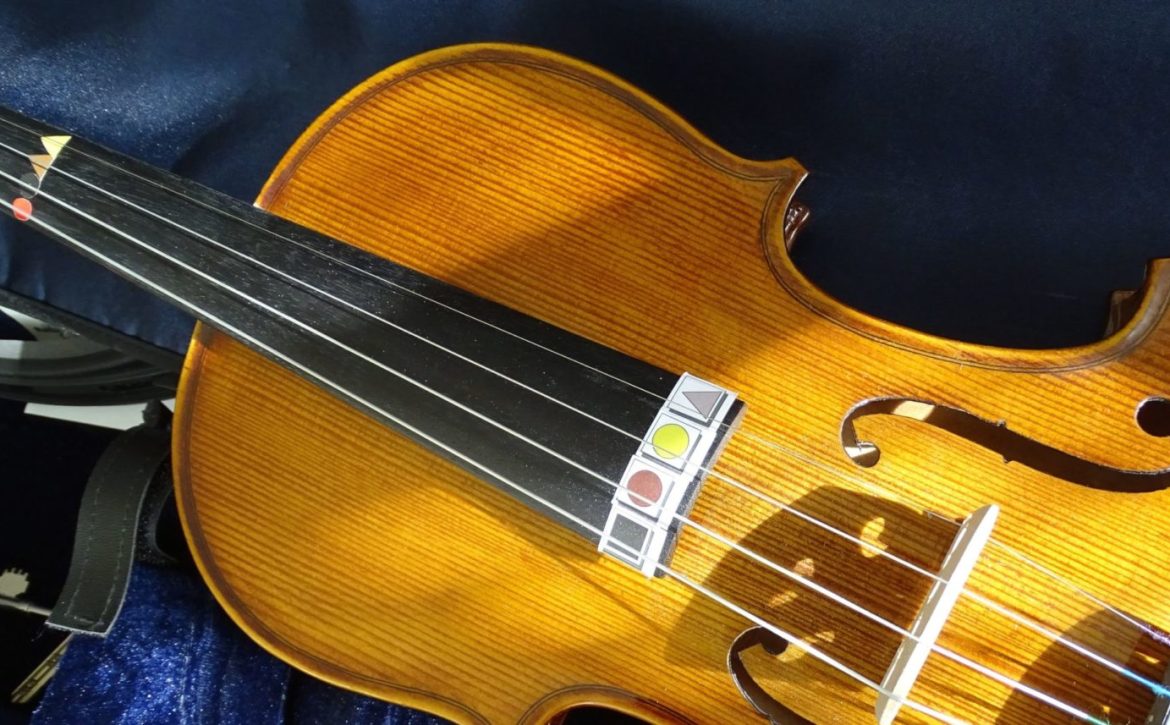
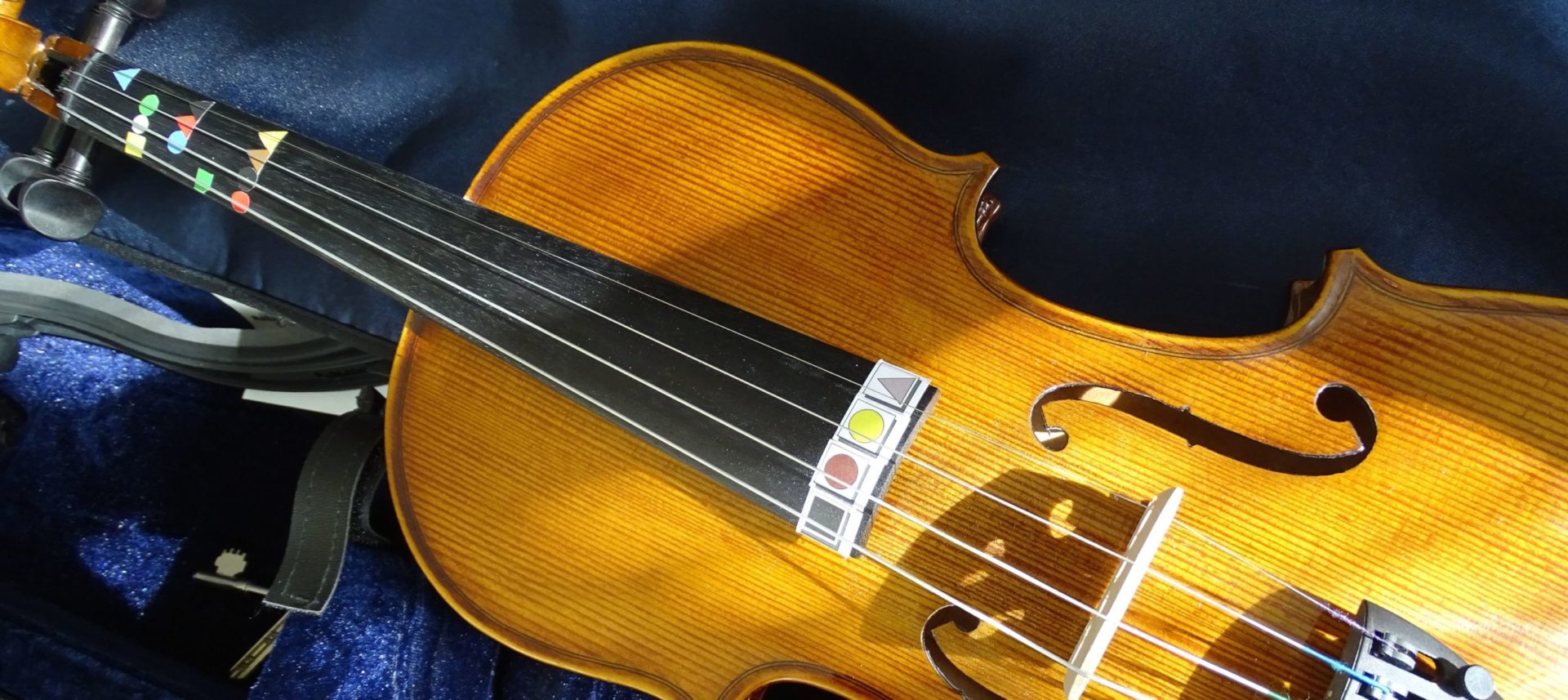
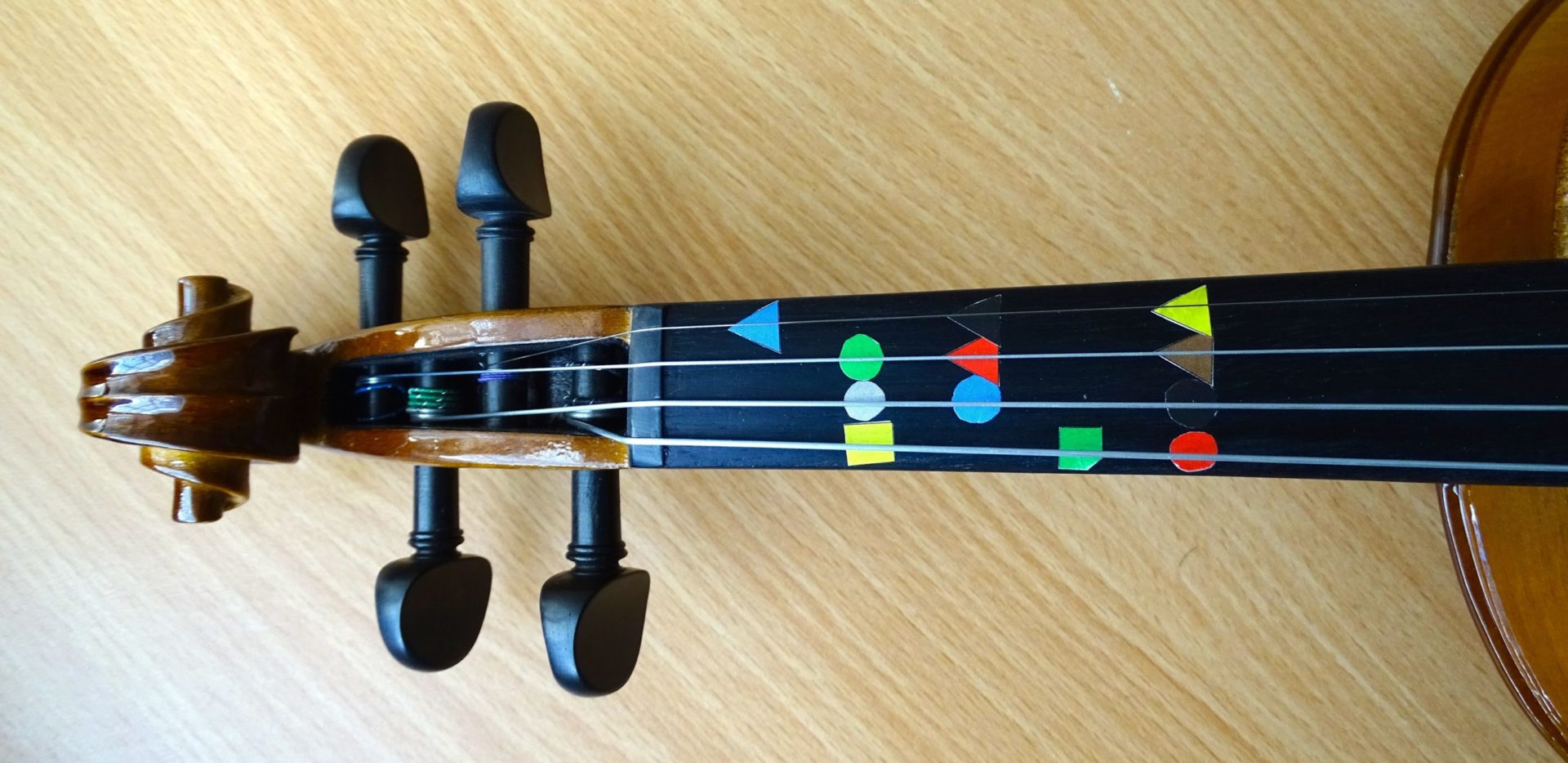
We start with open strings. Place a sticker at the end of the fingerboard, nearest the bridge, for each string. You can also place the open string stickers on the bridge itself. Take a look at the photos below to get a better idea. You can play using just these stickers for a while, to build up your technique and sense of rhythm and pulse. This also helps to focus your pupil’s eyes on the point where the bow meets the string, which helps create a good tone and bow control.
When you are ready to proceed to using fingers, try placing stickers on the ‘natural’ notes. This is slightly different to the way a lot of teachers use stickers on string instruments. Often, we will place stickers where the fingers will go. By using stickers on the natural notes, you encourage the ear while sneakily teaching a little music theory at the same time. Take a violin E string, for example; as a beginner, we will learn to play an F# on this string before we learn F. In Figurenotes, an F# is blue with an upwards arrow. If we are teaching this upwards arrow from the start, accepting this as an F# and knowing what that means in practical terms, we are sneaking in these abstract concepts in a very concrete way from the beginning.
If you still want the help of sticker strips to aid finger/thumb placement, use a non-Figurenotes colour, such as white. Place this underneath the Figurenotes stickers.
Once again, the BBC have asked us to create accessible resources for their Ten Pieces initiative.
The BBC are launching their third list of ten pieces, all chosen with the aim of opening up the world of classical music to a new generation. BBC Ten Pieces invites students to develop their own creative responses using a variety of art forms. Figurenotes resources echo this aim, with everything from composition worksheets, to poetry inspiration, and parts in Figurenotes notation. Some tunes are more complex, which we have included for the more advanced Figurenotes musicians, with plenty for beginners too. Remember that you can tailor the parts using the Figurenotes software, making them simpler or converting the parts to stage 2 or 3 for students progressing to conventional notation. You will find editable resources within the Figurenotes Resource Base. PDFs are available for many of the pieces from the BBC Ten Pieces website.
Want even more resources? Join the Figurenotes Resource Base for access to more from BBC Ten Pieces and many other Figurenotes resources, which are easy to tailor to your pupils’ needs.
I know you teachers are a committed bunch and spend much of your holiday time thinking about next term and updating your lesson plans. With that in mind, I’d like to give you a little inspiration for your upcoming lessons. If this feels too much like hard work right now, save this blog and come back to it when you’ve finished lazing by the pool.
1. Have you ever created music using Lego? Use the different sizes and colours of the bricks to create Figurenotes tunes. You can then develop this activity to learn rhythm in standard notation. Maths teachers have been using this method for years!
Did you know that you can buy individual lego bricks? This means you can create a pack directly suited to your needs. All the Figurenotes colours are available from the lego site, just make sure to order all the different sizes you’ll need. This is a great way to teach dotted rhythms, key signatures, and general rhythm reading skills in both Figurenotes and standard notation. You could always put a call out for unused Lego in your local community too.
There are some great templates for Lego music making on Pinterest.
You could create some card versions, either large for whole class work, or small for individuals and small groups. If your pupils are young or have difficulties with motor skills, you might want to start with Duplo.
2. Poly-pockets – you know, those transparent, plastic pockets used in ring-binders – make great miniature whiteboards. Pop a worksheet or empty score inside and use dry-wipe markers to fill them in. You can get dry-wipe markers in Figurenotes colours from IKEA if you want to create a tune or use colour within the worksheet. These poly-pockets can then be wiped clean, ready for the next pupil/class. If possible, it would be amazing to have small magnetic whiteboards for each pupil, but this is a good standby for when budgets are tight.
If you want to share your pupils’ tunes, you can take photos of them and project them using Powerpoint for the whole class to play.
What are the learning points you would like us to create worksheets for? Let us know in the Facebook group: Figurenotes – Let’s Make Music. We want to put many more up in the Resource Base and want them to be relevant to you.3. Art Attack! You will need: paper plates, masking tape, paints in Figurenotes colours.
There are so many games you can play using just these items, which can then progress further into note naming and reading standard notation. Take a look in the Resource Base, under ‘General’, for the Progression Games sheet. We love games and think they offer brilliant stealth learning opportunities.
Paint the paper plates in Figurenotes colours – you can either keep them as circles, or cut them to the desired shape. Lay out a Figurenotes score using the masking tape, either on the floor or a table. Start with 4 bars and see if you can compose a tune using your paper plates. Try playing this tune on your instrument.
You can take it to stage 2 by creating a masking tape stave and placing the plates in the appropriate places. Turn this into a quiz or a composition exercise. To take it to stage 3, write the note names on the back of the plates. Place them in the correct positions with the coloured side up. Then get your pupils to name the note before turning the plate over to see if they were correct.
Let us know what other games you would play using these items in the Facebook group: Figurenotes – Let’s Make Music4. 100 Day Practice Challenge – All of my pupils love a challenge, when presented to them as such. If it is just a hard thing to do, then they aren’t playing ball, but as soon as it is a ‘challenge’, they are motivated to try. In order to build good habits and develop practice skills, we need to encourage pupils to practise consistently. The 100 Day Practice Challenge can be a great incentive to build those skills. You can do this in smaller chunks, should you or your pupils prefer, breaking it down to a week to start with and then develop from there. Some teachers create charts or use apps to record the practice sessions. Put landmarks within the timeline, such as gaining a sticker on your chart at 25 days. It is useful to have ideas for practice focus, as well as things to practise when you are away from your instrument. You could even make this competitive within your classroom or studio.
Use one of the Figurenotes 100 Day Challenge maps or create your own. Colour in each shape in a Figurenotes colour to show you have completed your practice for that day. Get a sticker from your teacher every time you reach a number ending in zero. There is a bundle of sheets on the Resource Base, including 2 types of chart and some practice ideas for when you are with and without an instrument – so holidays won’t get in the way of you achieving your goal! Take a look in the Worksheets section.Not a member of the Resource Base? Get unlimited downloads for a whole year for just £23.99. You also get a discount on our award-winning training days. The next Music Teacher’s Toolbox training is on Saturday 18th November, 2017. Book now!